Invoice requirements in the Netherlands: What must be mandatorily stated on an invoice?
As an entrepreneur in the Netherlands, it is important to be well-informed about the statutory invoice requirements. Proper invoicing ensures that you get paid faster, that you have everything in order for the Dutch Tax and Customs Administration (Belastingdienst), and that you prevent legal problems during a collection procedure. In this knowledge article, we discuss the mandatory information that must appear on an invoice, the exceptions to these rules, and provide several practical tips to optimize your invoicing process.
Mandatory information on an invoice
According to the Belastingdienst, an invoice must at least contain the following elements:
- Your full company name and address: Use the official name under which your company is registered with the Chamber of Commerce (KvK). This may be the legal name, but also the trade name.
- Name and address of the customer: The full name and address of the buyer.
- Your VAT number: This number identifies your business for VAT return purposes.
- KvK number: Your registration number at the Chamber of Commerce.
- Invoice number: Use a unique and sequential number for every invoice.
- Invoice date: The date on which the invoice was created.
- Date of delivery or service: The date on which the goods were delivered or on which you performed the services.
- Description of the goods or services delivered: A clear description of which goods or services were delivered.
- The amount to be paid: State the amounts to be paid, excluding VAT. If there are products or services with different VAT rates, you must state the amounts separately. For a complete picture, you may also state the quantity and unit price.
- VAT rate: The percentage of VAT applicable to the delivered goods or services.
- VAT amount: The total VAT due for all delivered goods or services.
- Total amount: The total amount charged, including VAT.
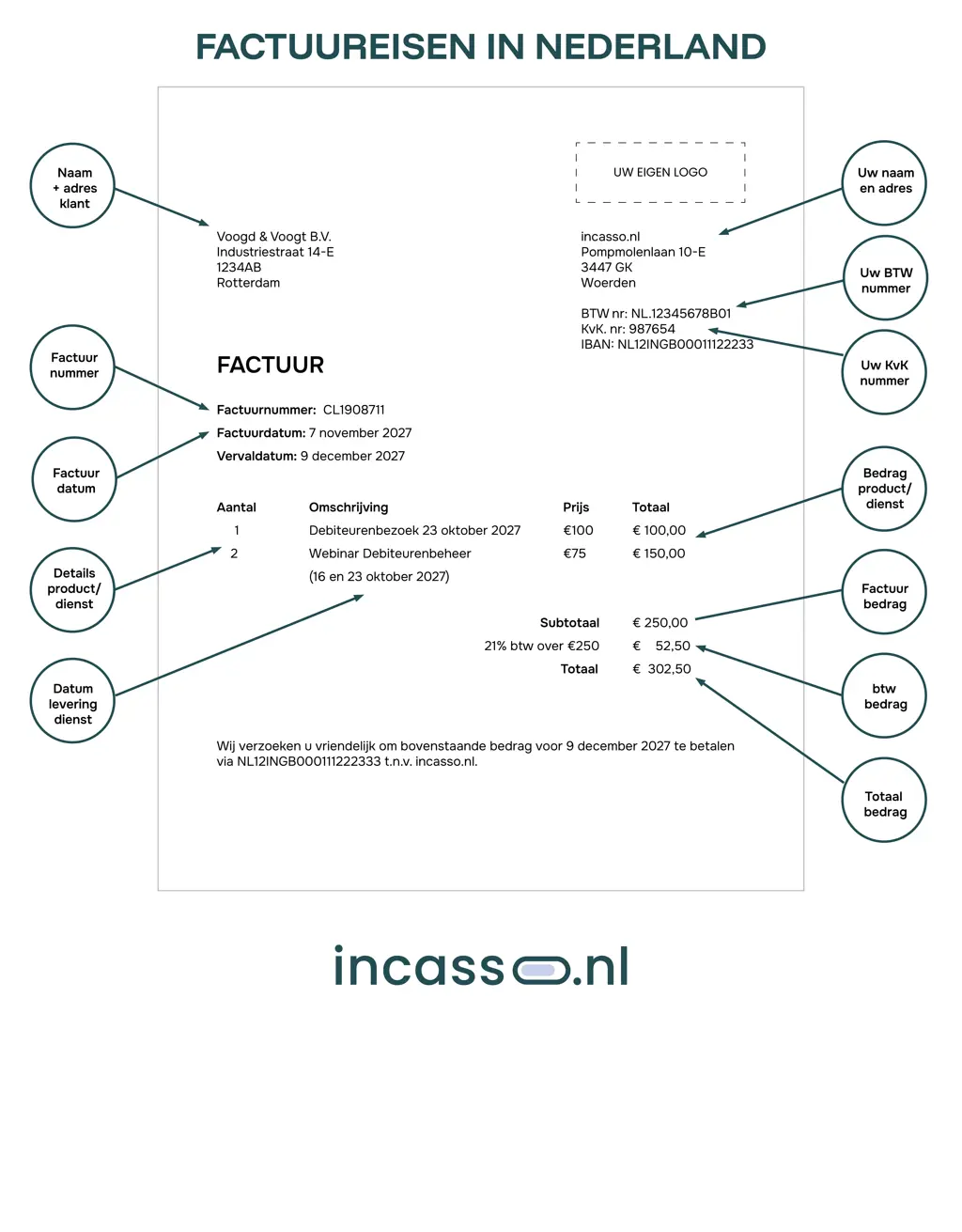
The above data is mandatory to ensure that you, your customer, and the Tax Authorities have a clear overview of the transaction.
Adjusted rules and exceptions
In some situations, different rules apply to invoices:
Invoices under €100
For invoices with a total amount of €100 or less (including VAT), fewer details are required. This reduces administrative burdens for small transactions. In this case, it suffices to put the following information on the invoice:
- Name and address of your company
- The invoice date
- Summary of the goods or services delivered
- The VAT amount included in the price, or the data needed to calculate that amount.
International transactions
Different rules often apply to deliveries to customers abroad. For customers in other EU countries, you must state both your own VAT number and that of the customer. In addition, you use 0% VAT for foreign customers and must indicate that it concerns an intra-community supply.
It is advisable to check the specific rules in your customer's country for certainty. This prevents potential problems. Furthermore, when delivering goods, it is good practice to keep important documents, such as customs papers and transport documents.
Small Businesses Scheme (KOR)
Entrepreneurs participating in the small businesses scheme are exempt from VAT and do not have to file VAT returns with the Tax Authorities. They are also not required to send invoices. If the entrepreneur does send an invoice, it must be stated that the entrepreneur participates in the small businesses scheme.
The importance of good invoices
There are several reasons why it is important that sales invoices meet all statutory requirements.
Correct VAT administration
Meeting statutory invoice requirements is crucial for correct VAT administration. A good invoice ensures that VAT is calculated and paid in the correct manner. Additionally, you ensure that in the event of an audit by the Tax Authorities, you can demonstrate that you have met all obligations. Incomplete or incorrect invoices can lead to fines and the loss of the right to VAT deduction. For example, if you send customers an invoice that does not meet all requirements, there is a chance they may not be allowed to reclaim the VAT on the invoice from the Tax Authorities.
Getting paid faster
A good invoicing process contributes to timely payments. If all necessary information is on an invoice, the customer knows exactly what is being charged and why. This reduces the chance of misunderstandings and payment delays. Furthermore, it is important to make payment itself as user-friendly as possible, for example, with a direct payment link in the email containing the invoice.
Standing stronger in collection procedures
An invoice that meets all requirements is stronger in legal procedures than an invoice where important elements are missing. For example, in Ambtshalve Toetsing (Ex-officio review), a judge uses a checklist to see if all conditions are met. Defective invoices with missing information can result in a legal claim being decisively rejected, even if you, as an entrepreneur, are in the right.
To stand stronger in legal procedures, besides invoice requirements, it is very important to communicate clearly about general terms and conditions, payment conditions, and payment terms.
Practical tips for your sales invoices
Reduce risks during the invoicing process with the tips below.
- Use invoicing software: Modern invoicing programs ensure your invoices automatically meet statutory requirements and assist in maintaining your administration. Furthermore, payment links and e-invoicing can be set up more easily, and invoices are kept safely.
- Check all contact details: Ensure all customer details are correct and up-to-date to prevent errors on the invoice. Incorrect contact details can also lead to slower payments.
- Set clear payment terms: Explicitly state the payment term and any consequences for late payment to prevent misunderstandings.
- Work with a collection partner: If a customer does not pay the invoice, it is important to take action in time. A collection agency can help you collect the invoice.