Holiday allowance is on its way! What should you look out for?
May is traditionally the month of holiday allowance. Thanks to this holiday pay, private individuals temporarily have more spending power. On the other hand, companies are confronted with higher expenditures on employees. It is therefore important that companies handle this wisely. Transfer your outstanding claims to your collection partner in a timely manner.
Consumer spending
Due to the holiday allowance, consumers in the Netherlands gain access to approximately 32 billion euros. Contrary to what the name suggests, this is not only spent on vacations by consumers. In fact, many Dutch people have all sorts of other goals for this extra spending power.
Although we can now travel freely again, a relatively small part of the holiday allowance is actually spent on vacations. According to recent studies, about 24% of the Dutch spend their holiday allowance on vacation.
Filling gaps after loss of purchasing power
A large portion of people indicate that they need the holiday allowance to make ends meet financially. They simply need it to fulfill all their obligations. Paying off debts is still in the top three when it comes to spending the holiday allowance. It is estimated that 9% of the total holiday pay is used for this. This trend has been reinforced in recent years by rising inflation.
You, as a company, could benefit from this trend.
Tip! Don't miss out!
Despite increased costs, the outlook for many people and businesses is positive again. Many people are craving a well-deserved vacation abroad. The expectation is that more money will be spent on leisure this year, meaning less money is available for paying off debts.
Therefore, ensure that unpaid bills are transferred to Ultimoo in a timely manner. Otherwise, your debtors will have already earmarked their holiday allowance for something else.
Corporate spending
Many companies are confronted with a significant increase in outgoing liquid assets in the month of May, as they must pay out the holiday allowance to their employees. Some companies run into trouble due to this cash flow, as they no longer have liquid assets to pay certain bills or debts themselves.
In addition, financial aftereffects of previous economic fluctuations still play a role in 2025. Think of the repayment of support measures, increased interest expenses, or higher energy costs. This can also apply to your own company or your business debtors.
Tip! Take action!
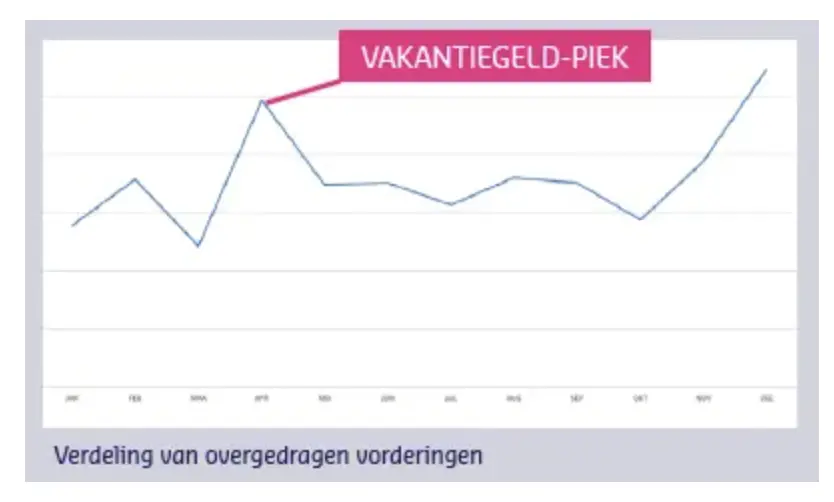
In practice, we see that some companies do not 'save' for the holiday allowance. The outgoing cash flow at the end of May is extra painful for them. Therefore, ensure you have sufficient liquid assets yourself. One of the measures you can take is the timely transfer of outstanding claims.
Are you curious about what other companies are doing? We see a clear increase in transferred claims among your competitors in the month of April (and May).